

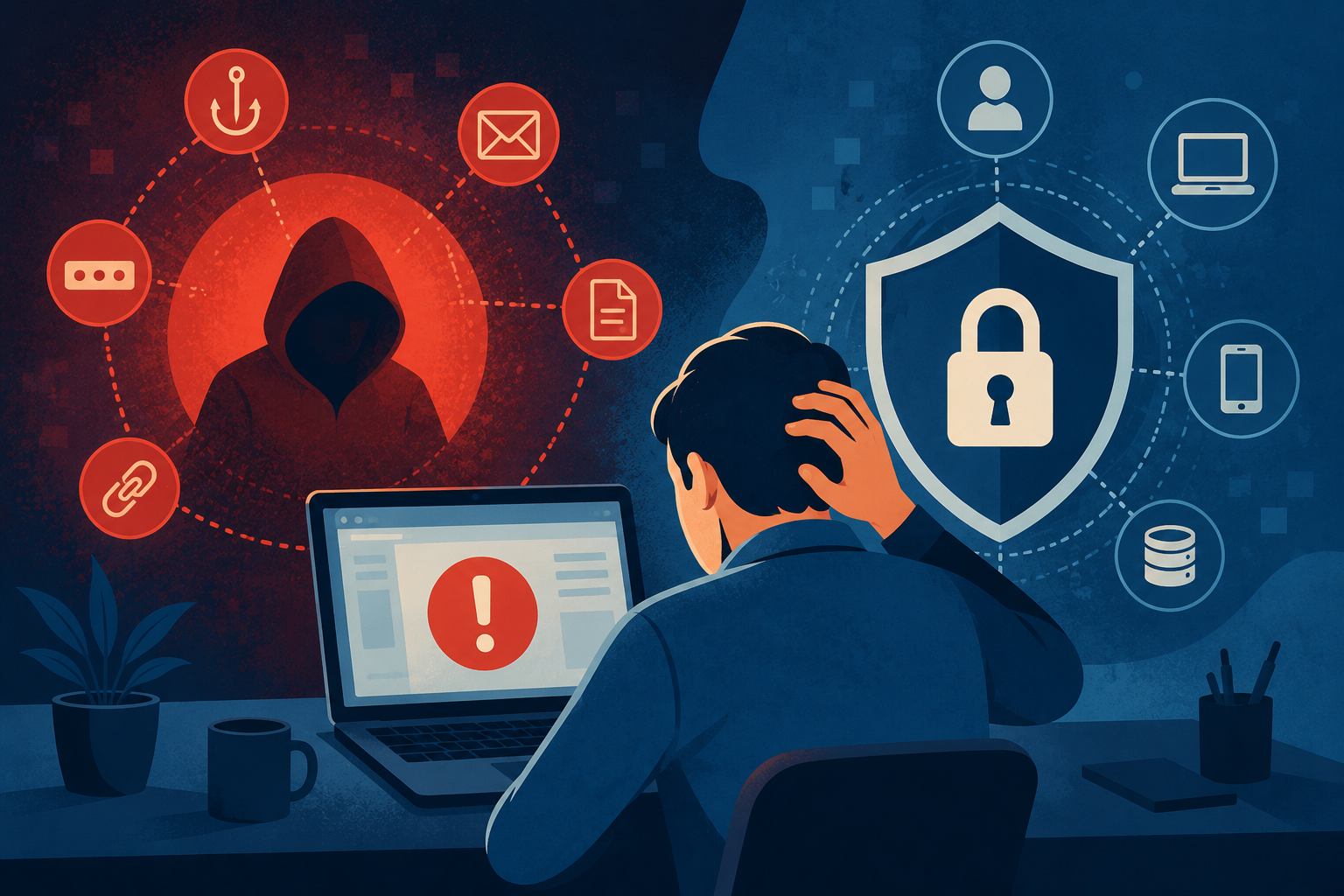
The Most Dangerous Threat to Your Business Is Already Inside the Building
Picture the scenario: a staff member gets an email that looks like it's from their bank, clicks a link during a busy afternoon, and enters their login credentials before realizing something is off. No sophisticated hacker needed. No advanced malware. Just a convincing email and a distracted moment. The majority of security breaches that hit businesses large and small trace back to exactly that kind of ordinary human mistake, not elaborate cyberattacks.
The fix does not start with buying expensive software. It starts with understanding how human error creates the gaps that attackers walk through, and what you can do about it.
Concerned about your business's security exposure? Find your local NerdsToGo to ask about a cybersecurity assessment.
The Most Common Human Errors That Lead to Security Breaches
Phishing is where most breaches begin. Not because employees are careless, but because the emails are engineered by people who study what makes someone click. A fake invoice from a familiar vendor name can be nearly indistinguishable from the real thing. An urgent password reset, a shipping notification timed just right, a message that looks like it came from a colleague: the design is deliberate, and it works on careful people.
Password reuse is nearly universal. Most people rely on one or two favorites across many accounts because creating and remembering a unique password for every service is genuinely unrealistic. The problem shows up the moment any one of those services gets compromised: every account sharing that password becomes vulnerable at the same time.
Software updates are consistently postponed. They interrupt the workday, they take time, and the risk of not updating feels abstract until it isn't. Attackers actively scan for devices running known vulnerable software versions, which means those postponed updates create real, exploitable gaps.
Shadow IT, meaning personal email, unapproved cloud storage, USB drives, and apps the IT team does not know about, creates blind spots. The business cannot protect what it cannot see.
Misdirected emails do not make headlines, but they account for a significant share of data incidents. Email autocomplete is the culprit more often than people expect. A contact with a similar name, a distracted click on the wrong suggestion, and a file containing customer data or internal financials lands in the wrong inbox. Unlike a phishing attack, this one comes entirely from inside the organization.
Why Smart, Careful Employees Still Make These Mistakes
The people making these mistakes are often your most competent, hardworking employees. Framing it as carelessness misses the point entirely. What changes the outcome is not finding more conscientious staff, it's changing the conditions they work in.
Cognitive load is real, and attackers deliberately exploit it. Phishing emails are engineered to create urgency and mimic trusted senders, with the specific goal of arriving when someone is least likely to evaluate carefully. A person juggling four tasks and a deadline who clicks a convincing link is not making a character judgment, they are making a human one.
Remote work removed a lot of the informal checks that used to happen naturally in an office. The ability to turn to a colleague and ask 'does this look right to you' is harder to replicate when everyone is distributed. Home networks, personal devices, and off-hours logins add friction and reduce visibility.
Most employees have never seen a real example of a phishing attempt. They have not had anyone explain what to look for, what to do when something feels off, or why password reuse creates a chain reaction of risk. Cybersecurity has historically been treated as an IT problem, which means the people piece gets left out. That is the gap that most breaches walk through.
What Small Businesses Can Do About It
The good news is that the highest-impact steps here are not expensive.
Start with training, and make it practical rather than procedural. A one-hour session that actually shows employees what phishing emails look like, how to verify a suspicious request, and who to tell when something feels off will do more than most software purchases. The key is making it a regular touchpoint rather than a one-time box to check.
Turn on multi-factor authentication. MFA requires a second verification step beyond a password, so a stolen credential alone is not enough to access an account. It is one of the highest-return security measures available and is free or very low cost on most business platforms.
A password manager handles the reuse problem without asking anyone to memorize a dozen complex strings. Strong, unique passwords get generated and stored automatically for every account. Business-grade options are inexpensive, and rolling them out across a team is straightforward.
Make it easy and safe to report something suspicious. Employees who are unsure about an email need to know exactly who to tell and that reporting something will not reflect badly on them. A simple, non-judgmental reporting channel catches problems early and signals that security belongs to everyone, not just IT.
Automate updates wherever the option exists. Where it does not, build a regular update schedule into operations rather than leaving it to individual employees to manage on their own time.
Where a managed IT partner earns its value is in the maintenance layer: monitoring for unusual activity, keeping configurations current, running phishing simulations to keep employee awareness sharp. These are the things that tend to slip when security is managed informally alongside other IT responsibilities. NerdsToGo's cybersecurity services work specifically with small businesses on this combination of people and technology.
When to Bring in Outside Help
Some of the situations where outside IT support earns its value quickly:
Nobody on staff has staying current on security threats as part of their job. That is the most common situation for small businesses, and it is not a criticism. Security is a full-time moving target. Without someone dedicated to tracking it, gaps accumulate quietly.
Something happened and nobody is certain what it was, or whether it is over. That uncertainty is exactly what a security assessment is for.
Sensitive data is involved: customer records, financial information, healthcare data. The compliance implications of a breach in these contexts are serious, and the cost of getting the foundation right from the start is considerably lower than addressing one after the fact.
NerdsToGo's cybersecurity services for small business are designed for exactly these situations. Whether you need a one-time security assessment or ongoing managed IT support, the goal is the same: fewer gaps, better habits, and a team that knows what to do when something looks off.
Frequently Asked Questions
What percentage of data breaches involve human error?
The honest answer is that the specific figure varies depending on who is measuring and how they define human involvement. What does not vary is the direction: virtually every major analysis of breach data finds that human behavior is a factor in the majority of incidents. The methodologies differ but the conclusion is consistent enough to take seriously.
Is cybersecurity training worth it for a small business?
For most small businesses, yes. Technical controls can limit the damage from a mistake, but they cannot prevent the mistake itself. An employee who has never seen a convincing phishing email, or who does not understand why their password matters, is going to create risk that software cannot fully catch. Training does not need to be expensive. Practical sessions focused on what to watch for and what to do when something feels off are enough to make a real difference.
What's the easiest first step to reduce human error risk?
Turn on multi-factor authentication. An hour of setup across your business accounts removes a significant portion of the risk from compromised passwords.
Talk to your team. Show them what a phishing email actually looks like. Tell them who to contact when something seems off. This costs nothing and changes behavior immediately.
A security assessment is the right next step if you want to know specifically where your gaps are rather than guessing.
Ready to take an honest look at your business's security posture? Find your local NerdsToGo and ask about a cybersecurity assessment. The Nerds are here to help.